
A Journey to Research in Computer Science
Build a professional career with industry experts.
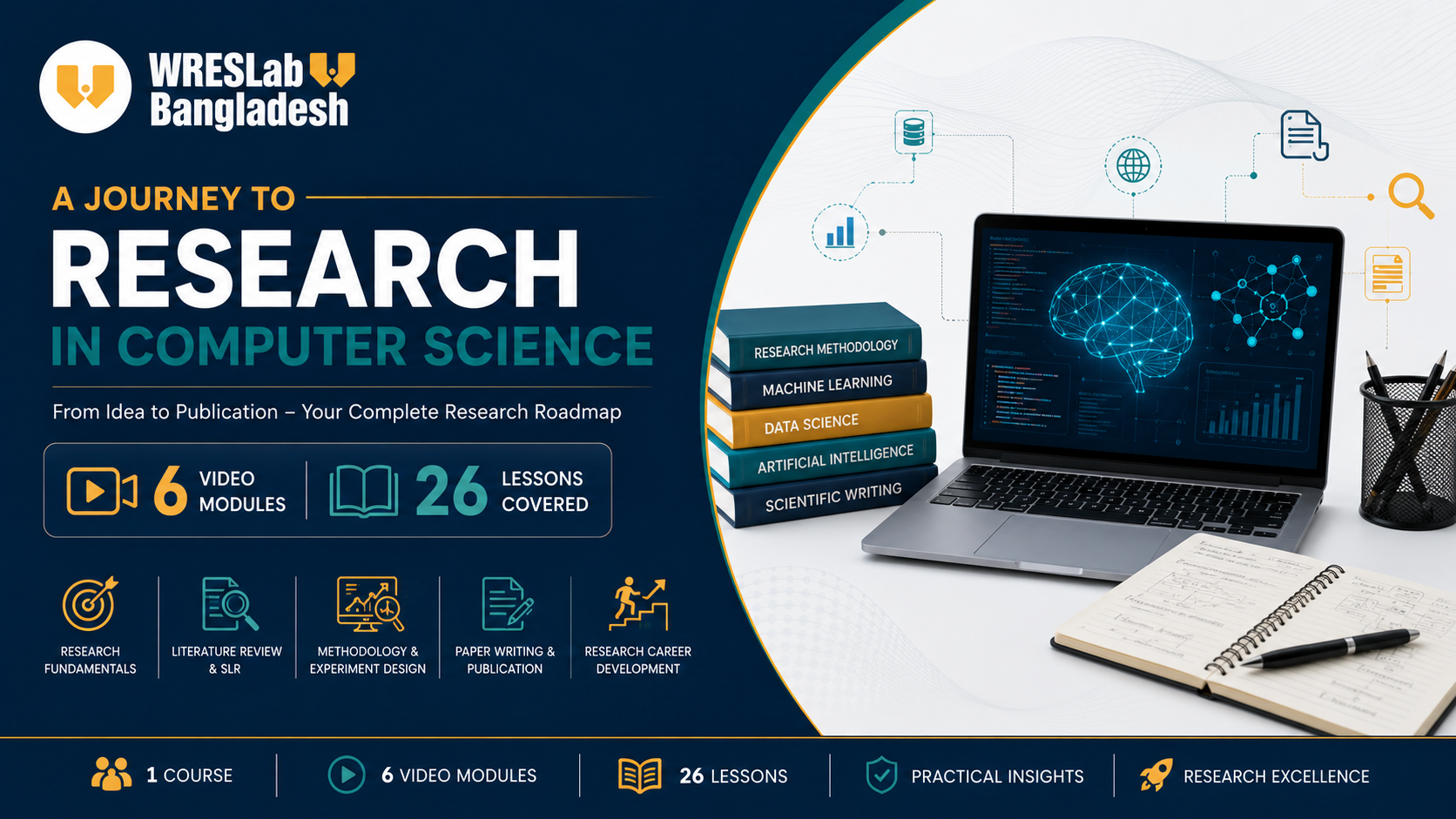
This course includes:
-
Beginner-friendly roadmap for starting computer science research from zero.
-
Coverage of research topic selection, problem formulation, and gap identification.
-
Dedicated focus on literature review and Systematic Literature Review (SLR).
-
Practical guidance on research methodology, datasets, experiments, and metrics.
-
Hands-on orientation to research tools such as Google Scholar, Zotero/Mendeley, and Overleaf.
-
Academic writing guidance for abstracts, introductions, related work, methodology, results, and conclusions.
-
Publication guidance for journals, conferences, indexing, submission, and peer-review response.
-
Ethics-focused discussion on plagiarism, citation, AI tool usage, and research integrity.
-
Useful for thesis, final-year project, journal paper, conference paper, and research career preparation.
Core Features
Structured Research Roadmap
A step-by-step learning path that takes learners from basic research concepts to publication preparation.
Research Topic Development
Guidance on selecting a domain, finding problems, defining objectives, and shaping a publishable research idea.
Literature Review Training
Practical methods for searching, reading, summarizing, comparing, and organizing research papers.
SLR and PRISMA Orientation
Focused training on systematic review planning, screening, quality assessment, and reporting.
Academic Writing Support
Clear explanation of each major research paper section with writing tips and common mistakes.
Tools-Based Learning
Exposure to essential research tools for references, writing, plagiarism control, and publication preparation.
Publication Strategy
Guidance on journal/conference selection, indexing, submission steps, revision, and reviewer response.
Ethical Research Practice
Discussion of plagiarism, citation, AI-assisted writing boundaries, and responsible research behavior.
Career-Focused Outcome
Designed to help learners prepare for thesis work, research assistant roles, higher studies, and publication-driven academic growth.
Computer Science Domain Relevance
Examples and activities can be mapped to CS domains such as AI, ML, data science, cybersecurity, IoT, and software engineering.
What You Will Master
Curriculum Topics
Topics 1 Introduction to Research in Computer Science Topics 2 Understanding Research Problems and Research Gaps Topics 3 How to Choose a Research Domain in Computer Science Topics 4 From Idea to Research Question Topics 5 Research Objectives, Hypotheses, and Contributions
Topics 6 Searching Research Papers Using Academic Databases Topics 7 Reading and Summarizing Research Articles Efficiently Topics 8 Building a Literature Review Matrix Topics 9 Writing a Strong Related Work Section
Topics 10 Introduction to Systematic Literature Review Topics 11 PRISMA-Based Search and Screening Process Topics 12 Inclusion, Exclusion, and Quality Assessment Criteria Topics 13 Data Extraction and Synthesis for SLR
Topics 14 Research Methodology Design in CS Topics 15 Dataset Selection, Data Collection, and Data Cleaning Topics 16 Experimental Setup and Baseline Comparison Topics 17 Evaluation Metrics for CS Research Topics 18 Reproducibility, Validity, and Ethical Issues
Topics 19 Using Zotero/Mendeley for References Topics 20 LaTeX, Overleaf, and Manuscript Formatting Topics 21 AI Tools for Research: Ethical and Responsible Use Topics 22 Writing Title, Abstract, and Keywords Topics 23 Writing Introduction, Methodology, and Results Topics 24 Creating Professional Tables, Figures, and Graphs
Topics 25 Journal/Conference Selection and Submission Topics 26 Reviewer Response, Revision Strategy, and Research Career Plan
Video Lessons
Module 1 - Research Foundation in Computer Science
59Module 2 - Research Paper Searching, Reading, and Literature Review
58Module 3 - Systematic Literature Review and PRISMA Methodology
53Module 4 - Research Methodology, Experiment Design, and Evaluation
59Module 5 - Research Tools, Manuscript Writing, and Visualization
53Module 6 - Publication, Revision, and Research Career Development
48Now Playing
Progress auto-saves
Lead Instructor

Md. Wahidur Rahman
CEO, Wreslab Bangladesh
Common Questions
This course is for undergraduate students, graduate students, fresh researchers, thesis/project students, and professionals who want to start computer science research and publish academic work.
No. The course starts from the fundamentals and gradually moves toward literature review, methodology, writing, and publication strategy.
Basic computer science knowledge is helpful. Programming is not the main focus, but learners working in AI, ML, data science, cybersecurity, or software engineering will benefit from basic coding experience.
Yes. The course covers paper structure, title, abstract, introduction, related work, methodology, results, discussion, conclusion, references, and publication formatting.
Yes. A dedicated part of the course covers SLR planning, PRISMA flow, search strings, screening, quality assessment, data extraction, and reporting.
Yes. Learners will practice identifying limitations in existing studies, comparing recent papers, and converting gaps into research questions and objectives.
Yes. The course explains how to select journals/conferences, check indexing, avoid predatory publishers, prepare manuscripts, submit papers, and respond to reviewers.
Yes. It is useful for thesis planning, literature review, methodology design, experiment organization, academic writing, and project-to-paper conversion.
The course can introduce AI tools for idea organization, literature exploration, language improvement, and productivity, with emphasis on ethical use and avoiding plagiarism.
Learners should have a clear research roadmap, a selected research topic or draft idea, a literature review plan, understanding of methodology, and a basic manuscript/publication strategy.